Remembering Loved Ones

Every experience of grief is worthy of journalling your feelings. Facts and emotions are too easily forgotten. When this happens they lose their significance and heartfelt meaning. A paragraph or two will cause a flood of memories to flow that were once emerged into daily living. You may never do anything more with your memories than jot a few notes and over time, add a few more points of reality and sentiments. You might not feel called upon to act on those impressions. But then again, if you decide to send a letter or a card to someone connected to your experience, that’s a bonus. You might bring some sunshine into another’s life.
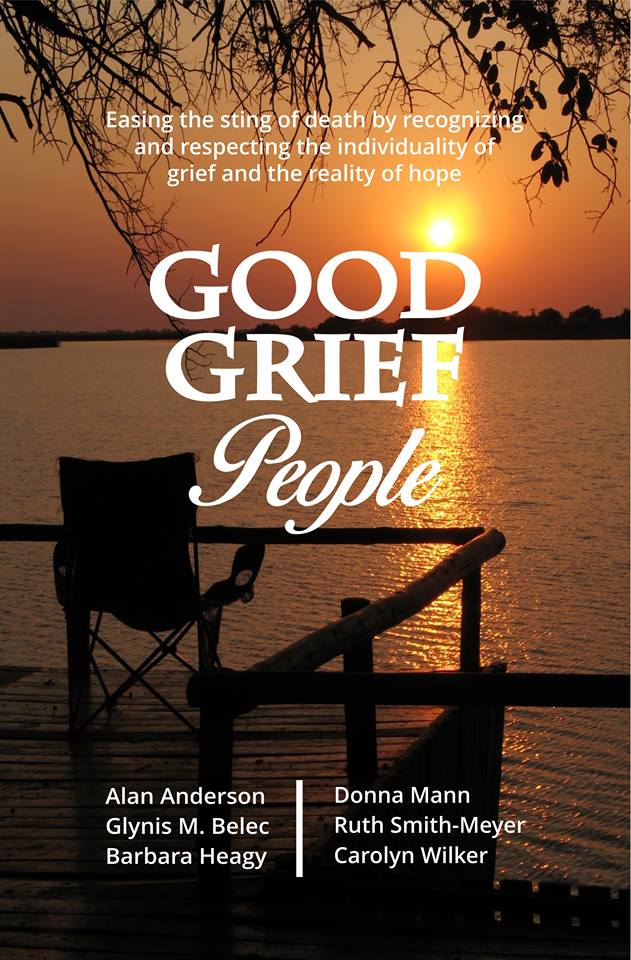
On May 17th, 2016, I received an email from Glynis Belec of Angel Hope Publishing inviting me to become part of a team she was building to write stories, poems, etc about grief. It didn’t take me long to accept her invitation. The team formed with five other writers along with our publisher. Although the stories were not always easy to recall and to write, I am privileged to see them within the covers of Good Grief People.,  Ten months later, on March 10th, 2017 we sat in Tim Horton’s excited to hold the book in our hands.

Good Grief People is a work of love, acknowledging our lives with others and sharing our loss. It validates how much we cared for people as well as our desire to know them in life and in their dying. It is a message of confidence that remembering, writing and sharing is important to keep our loved ones close to our heart. It is an invitation for those who read the stories to think about people they’ve loved. This invitation stretches us to write those memories down on black and white in letters, journals, blogs, emails and scribbles on whatever is handy.

If this blog reminds you of an experience of being with someone in their last days, take a few moments and write it in your journal. Six months from now when you reread it, you’ll be glad you did it. Visit http://www.donnamann.org for grief selections and other material.



Good Mourning

Often we skip a period of mourning and focus on grief. Mourning time is a valued space after personal loss – sometimes lasting longer than expected. Have a look at what Merriam Webster dictionary says about mourning:

  • mourning1
: the act of sorrowing mourning for her dead husband.>

2a :  an outward sign (as black clothes or an armband) of grief for a person’s death mourning — Arnold Bennett>

2b :  a period of time during which signs of grief are shown mourning, resume their ordinary dress>

My aunt wouldn’t take part in a family birthday party because she said she was ‘still in mourning’. This is honoured behaviour although we don’t often hear the word mourning.

I remember when my grandfather died, my dad put on a dark shirt. His suit was navy. As a teenager, I knew about colour coordination and mentioned he should wear another colour of shirt. All he said was, “This is proper”.

In my genealogy studies I often see pictures of black wreaths on front doors and black crepe paper used in decorating the house according to a family’s mourning traditions. It was not unusual in past eras to wear a black armband for a short period. This is not practiced now in local cultures, but other actions signify grieving and the need to have time alone.

After my father’s death, I remember thinking it wasn’t respectful to do certain activities in the same week. There used to be a definite three-day waiting period to observe a death in the family. This too has changed over the years. Families take responsibility for these decisions.

Mourning is a good word as is grief. Consider Elizabeth Gilbert’s use of these words:

“Someday you’re gonna look back on this moment of your life as such a sweet time of grieving. You’ll see that you were in mourning and your heart was broken, but your life was changing…”― Elizabeth Gilbert (Goodreads)

Write a few thoughts about your pattern of mourning and grief.

Notepad_icon

To be or not to be – angry

I’m late in getting my mid-month grief blog published. One huge reason, although the  Christmas season provided its own, was contributing to a grief anthology. The publisher good-grief-people-coverwanted personal stories. As part of my process, I found it interesting to see how many times I remembered feelings of frustration and anger. In hindsight I see they were healthy contributions to my process of grief and have dissolved over time.

Too often we think these feelings are negative, so we deny them thinking we’re protecting our well-being. Keep in mind as long as they are not harmful to you or others, we can take our time to work through them. Anger is one emotion that is often misunderstood.

It is not uncommon to see both deep-seated anger and/or easily-fused anger in grief. Anger can surface for many reasons. It is sometimes mixed with fear of the unknown. This happens especially when individuals are not informed about what happened, how or why. Often they want answers even at times when there are none. They can be angry at God, doctors, ministers, funeral directors, neighbours, family and friends, even themselves. There is no end to the list. Yet, once they understand, anger often dissolves. Unfortunately, we sometimes think grief is about emotions and experience. But, grief is as much about knowledge and learning as it is about feelings.

People can shy away from used and abused one-liner religious clichés. Many choose  to work through a logical and practical process. This is another good beginning to understanding grief.

Granger Westberg wrote this: “When we say anger and resentment are a part of “good grief,” we probably should qualify this . . . these feelings are normal for every human, and that even the most devout persons can very well feel angry and resentful, even though we try very hard to sublimate these feelings (Good Grief (1971) p.61) Fortress Press).” He suggests that we face these emotions and in time rise above them.

Take a few moments and write down some facts and feelings about anger in your grief journal.

Notepad_icon

WinterGrief

In Canada, we are beginning a rather furious winter. We didn’t have much snow until a couple of days ago, and now we have road closures and blizzard conditions. However, most of us have put snow tires on our car, checked our supply of windshield washer and purchased an extra pair of warm mitts. We are prepared.

Some may love winter for sports and other interests. Some don’t like winter for many reasons. However, the earth in this area is very thirsty after a long dry summer. And we know that spring will come in all its glory. So I suppose we will find ways to endure the winter months.

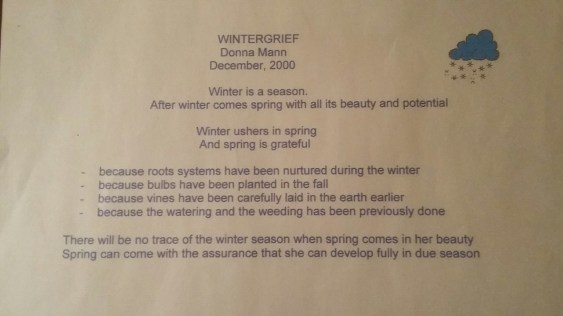
Grief is sometimes like that. When I wrote WinterGrief, I compared nature’s seasons to the nature of grief. Yes, some nice comparisons. I’ve attached an old piece of paper where I did some pondering. I hope you enjoy it.

wintergrief

WinterGrief cover

Notepad_iconJot some of your pondering, leave it for a while and then glean the wisdom of your words.

==========

donnamann.org = for more prose, stories and pictures.


Grief, Mourning and Loss

Tags

, , , ,

horizon-image

“The reality is that you will grieve forever. You will not ‘get over’ the loss of a loved one; you will learn to live with it. You will heal and you will rebuild yourself around the loss you have suffered. You will be whole again but you will never be the same. Nor should you be the same nor would you want to.” ― Elisabeth Kübler-Ross


Kubler-Ross’s words may seem harsh – they’re not. They can be very healing. Notice there is a present status and then explanation. There is hope in every sentence. Words can be turned over and around to mean different things to different people, but there is a base line of understandig. What is helpful to one person isn’t always so for the next one. However, most words have a common denominator that will stand on their own.

Having said that, there are people who get stuck in grief because of words we use. They may have the language of recovery, but their actions and attitude may show something very different.

It can be helpful to reflect on both the word grieving as the internal expression  – an emotional reaction or response to loss. While mourning is the external expression. We might ask ourselves, “Am I grieving or am I mourning?”

Mourning can be the process I use to deal with my loss. It is often the ache, and how I cope with that feeling. Many years ago, men used to wear a black armband when they were in mourning, or a woman might wear a veil. In today’s society we are not so visible in our mourning, however we still do it.

Loss can refer to any kind of disappearance – great or small severe change in our life where what was, is now no more. It can be anything from losing Grandma’s pearl ring to mislaying my tickets to the Maple Leaf game, to a dear friend’s death.

In some ways, I’m experiencing grief at this time. There is a sense of loss of relationships through the play I was directing. Months of practice can never be replayed. Its over – never to be again as it was. Yet, I can reclaim the faces, the laughter and the music through my memory. Even though that’s true, I still suffer loss.

Notepad_iconSketch a feeling or jot down some words about grief, mourning and loss. Then identify with a particular loss you have recently experienced.

Donna

Grief is . . .

“Grieving is a process. Grieving is not an event. Grieving is not learned. It comes naturally when we give ourselves permission and if we let it take its course.

We cannot always explain, define and understand what is happening to us. We have to trust ourselves that we can naturally respond to the new state into which we are thrust. It is about gaining confidence in our God-given ability to express emotions.

cemtery-womanGrief is a state of being, into which we enter caused by painful traumatic dynamics that surround us, or from circumstances out of which we are forced to respond.  Grief creates within us a phenomenon totally outside our everyday common vocabulary. Yet, often without support or companionship, we expect ourselves and others to live within the experience of grief, even when we have no words to define it. There is nothing fair about any of this.

We are called to learn guidelines and definitions that give us tools to speak to our heart and to articulate our journey to ourselves, others and God” (2003 Work sheet for Grieve and Grow course: Dr. D.Mann; Trinity Theological Seminary).

It is at times like this when a friendly voice, or helping hand helps us to trust ourselves, our story and the unpredictable future ahead. After learning and applying the principals of grief, freedom consumes us empowering us to live a new life.

Write some notes in your journal attempting to look at the before and after emotions in your life.

Notepad_icon

Letting it happen!

Tags

, ,

Do you lose patience if tears fill your eyes when you’re reading your favourite novel?  Is it because it reminds you of a painful experience in your own life?

This normal reaction to the printed word occurs when the content touches your heartstrings. Tears force the letters to fade on the page. You swipe them away, hoping to gain immediate clarity of the words. You’re eager to see what happens in the plot, but the tears win. The words appear and disappear like leaves blowing in the wind.

If you’re reading in bed, you grab a corner of the sheet to soak up the flood of tears on your face.

Holding your breath coaxes several hiccups. You realize you’re on the edge of bawling like a calf calling his mother. And after sleep claims you in the long dark night, you stir and feel the still damp sheet. The author’s well crafted words elicits a silent thank you to move across your peaceful mind. And you sleep.

Notepad_icon

Take a few moments to remember when someone’s words moved you onward in your grief process.

Healing Tears

Tags

, , ,

“Tears filled her eyes and spilled down her face, making the sleeve of John’s shirt wet. She wasn’t crying, not really. She was too numb to cry or feel or react. Rather her body was grieving all on its now, the tears leaking from her eyes without any weeping or sobbing or emotions” (REUNION: Karen Kingsbury, p. 204).

This insert comes from a novel. But, wait you say, novels are fiction so the above is not true. You might even test it and challenge it by saying, it’s the kind of statement I’d find it in a non-fiction book. But, then consider the old clichés, “Fiction is truer than history,” or fact, or truth and yes, even non-fiction.

I just returned from a holiday, and as usual I took many books with me. Because I write about grief and support families and individuals in their grief process, I find it interesting how an author unpacks his or her plot when someone dies in the story. In Reunion, a family grieves the death of a mother, grandmother, wife and friend, and Mom joins in the grieving process. It is raw honesty. Believable and healing.

And why not, when the dying is suffering the greatest loss. Her life. It is natural and normal for family to gather around their loved ones and cry openly. It is a good death when the dying joins in this last family time together. An invisible bond of trust, love and safety connects them.

Take a few moments and write in your journal, or sketch a picture. Trust to paper what comes to your mind

Notepad_icon

Life-lines are Revealing

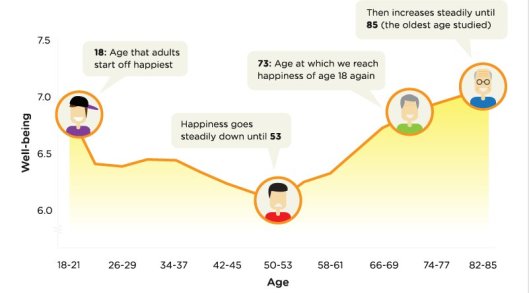
According to BusinessInsider.com, we gain freedom and happiness when we reach the age of seventy-three similar to that which we experienced as a young adult. Investors would agree with the former date, especially if we’ve carefully planned our retirement financially with solid relationships and peace of mind.

Midlife, as shown in the diagram, can often be a time of crash and burn. It can bring tremendous grief. Some parents see adult children making poor life-changing decisions never to be reversed. Sometimes an awareness of those in the family who are addicted to drugs and alcohol surface at this time. Relationships that have been hanging on for years, finally collaspe. Family breakups rearrange generational  pictures from one year to another. Changing jobs, moving from familiar locations and serious medical diagnosis can shatter dreams as the caption below states ‘happiness goes steadily down until age 53’.

Reading that happiness reigns from age seventy-three onward may be hopeful, but not always reality. It is through this range that retirement years can edge on loneliness, heartbreak and sickness. It can also be a time when poor choices are made and consequences dig life into a pit without a ladder. Granted, it would be nice if our early 70’s offer a familiar carefree lifestyle as the coming-of-age status. Perhaps that is our quest.

screen shot 2015-03-25 at 7.27.53 pm.png

Grief can take hold in many ways during any of these life stages. Whenever we lose sight or fail to find our footing toward our dream, grief reminds us we have work to do, thoughts to define and focused care to be given. Many people try to take crisis times in their daily stride, adding cliches such as, “It doesn’t rain, but it pours,” or “God doesn’t give you more than you can handle.” These phrases can add to the crisis causing excess anxiety and stress which can lead to a multitude of consequences.

Consider the life-line above, recall times of grieving, and explore ways it has affected your understanding of life’s changing events.

Notepad_icon

This is a perfect opportunity to scribble, doodle, draw or write a few notes as you reflect over your life.


Seasons of Grief

Tags

, , ,


‘Stages of Grief’ is not a favourite term for some people. Perhaps they fear having to experience them in a particular order. And if they don’t, they might think they’re doing something wrong. I find it helpful to think of manoeuvring my way through stages of grief. Sometimes it’s important to think of a silent dance without music – one step forward and two backwards. This often means you find yourself in a familiar stage while thinking you’d conquered it months ago.WinterGrief cover

I often use the term ‘Faces of Grief’. “I confront and practise them in no particular order. I face them time and again, sometimes together or one at a time. It is like moving through a crowd, identifying the faces I have grown to know so well, admitting the more I know them, the more I understand and am free to trust” (WinterGrief p.23).

I’ve come to appreciate the term ‘Seasons of Grief’. For children’s grief Dr. Donna A. Gaffney identifies several key seasons: the first day after death, services, re-entry to life following crisis; the first year; and significant life events of following years (p. 4). I think these particular times are important for adults as well.

Granted, one size doesn’t fit all when it comes to grief, but these concepts can be helpful. Consider applying the words below to grief:

Winter is a season
Winter ushers in spring
Spring eases in with all its beauty and potential for new life.
Spring leads the way into a new season of expectation and colour. Why?

  • winter has strengthened important root systems
  • winter has provided a cover for bulbs to prepare for spring
  • winter has protected vines tucked into the earth
  • caregivers have weeded destructive roots at significant times

When spring comes in her beauty, winter recedes – not to deny it will return.
Spring comes with assurance that she can develop in due season.

Notepad_iconJot a few notes in your journal